



- Home
- News
- Knowledge Center
- Bright Field vs. Dark Field: How Lighting Angle Changes What Your Camera Sees
Bright Field vs. Dark Field: How Lighting Angle Changes What Your Camera Sees
Run the same part through two different lighting setups and you can get two completely different images. Same camera, same part, same lens. The only thing that changed is the angle the light comes in at. That's really all bright field and dark field are.
THE PHYSICS
A flat surface reflects light like a mirror. Whatever angle the light comes in at, it bounces out at the same angle on the other side. The only thing that matters is whether that reflected light lands inside your camera lens or misses it entirely. Land inside the lens, the surface looks bright. Miss the lens, the surface looks dark.
Land inside the lens, the surface looks bright. Miss the lens, the surface looks dark.
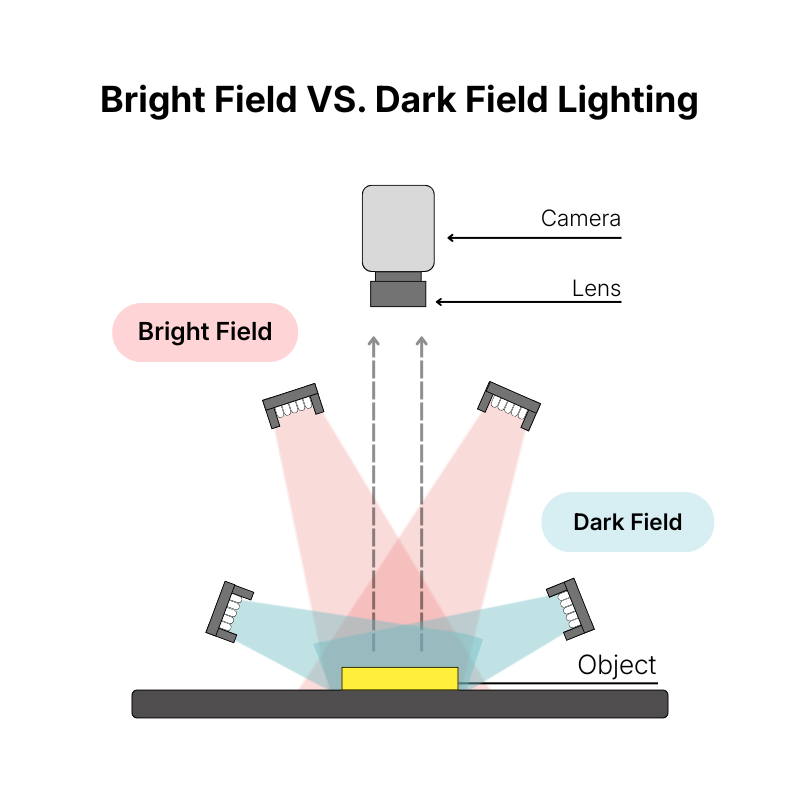
BRIGHT FIELD ILLUMINATION
The light is positioned so a flat, defect-free surface reflects straight back into the lens. A good part comes out looking uniformly bright. Now put a scratch, a dent, or a missing coating on that surface. The light hitting that spot no longer reflects at the same angle as the rest of the part, so it misses the lens. That spot goes dark against a bright background. Good part: bright. Defect: dark, standing out against it.
Common use cases: polished metal, silicon wafers, glass, anything with a flat specular finish where you're checking for presence/absence, flatness, or a coating defect.
DARK FIELD ILLUMINATION
The light comes in at a shallow, grazing angle, aimed so the reflection off a flat surface misses the lens on purpose. A good, flat part looks dark because there's nothing bouncing light back at the camera. Scratches, edges, engraved marks, dust, hairline cracks all break up that flat surface and scatter light in enough directions that some of it reaches the lens. Those features show up bright against the dark background. Here it flips: good part is dark, and the thing you're trying to catch is what lights up.
Common use cases: scratch detection, engraved date codes, hairline cracks, particulate and dust inspection, edge detection.
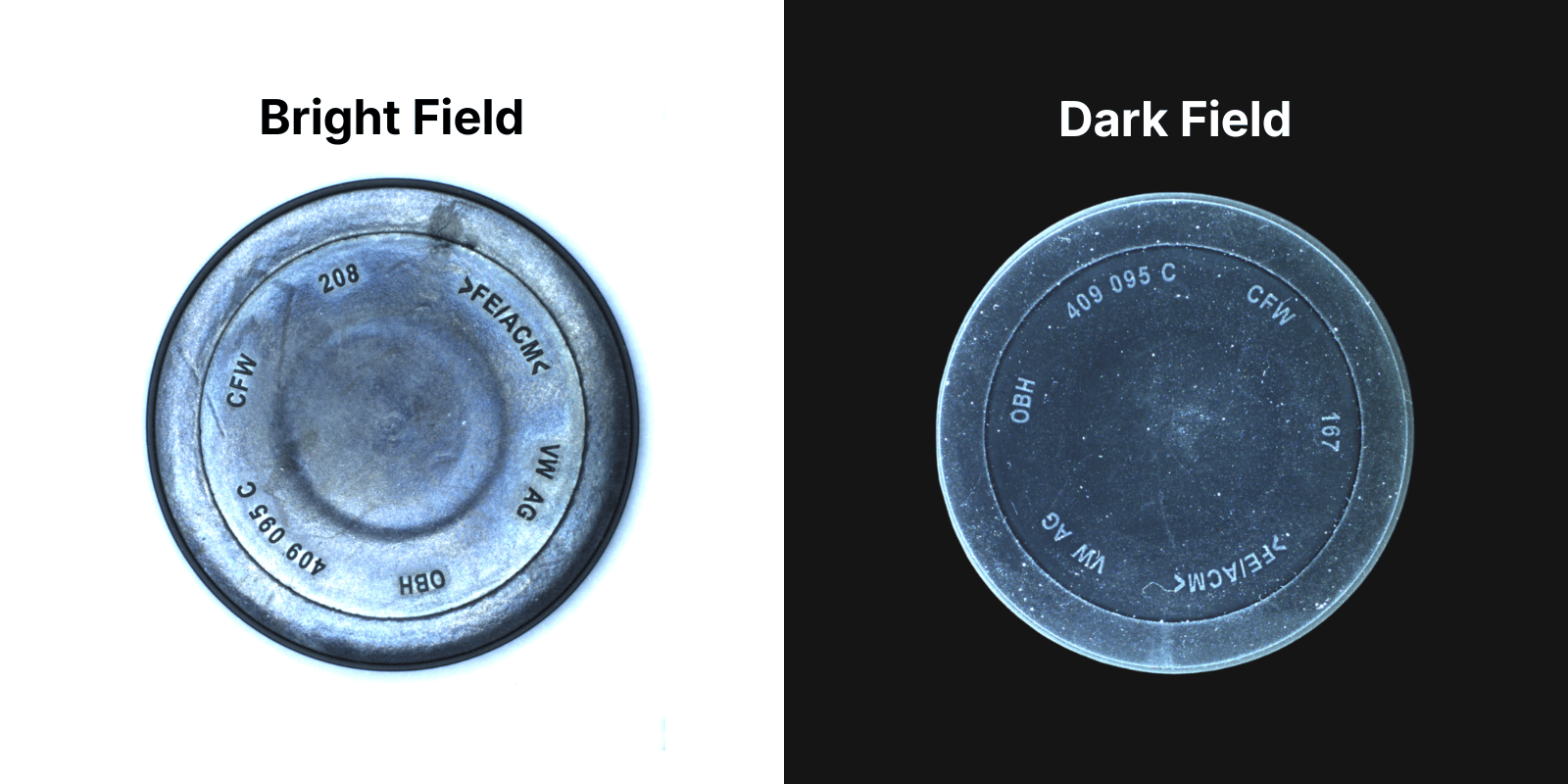
Why it matters for automated inspection
A camera does not notice a scratch the way a person does. It just reads brightness values, pixel by pixel. So the job of lighting is to make a good part and a bad part as different in brightness as possible. Get the angle right and even a basic threshold works reliably. Get it wrong and no amount of software can pull contrast out of an image that never had it to begin with.
A quick note on angle numbers
You will see different degree values varies depending on the source, and some suppliers do not clarify which reference point they are using. Some measure the angle from the surface itself (grazing is close to 0°, straight down is close to 90°). Others measure from the normal, the line pointing straight up off the surface (straight down is close to 0°, grazing is close to 90°). Same physics, opposite numbers. Worth checking before you compare two vendors' spec sheets side by side. For 3AM, we measure from the normal, where the light illuminates straight down is our 0°, and the grazing light is 90°.