


- Home
- News
- Knowledge Center
- Questions to Answer Before Choosing the Right Lighting
Questions to Answer Before Choosing the Right Lighting
Why we ask before we recommend
If you've contacted lighting suppliers before, you may have experienced this: you describe your application briefly and within minutes receive a product recommendation — sometimes even a quote.
That might feel efficient. In reality, it's a red flag.
There is no universal "good lighting" in machine vision. The same ring light that works perfectly for PCB solder joint inspection will fail completely on a polished metal surface.
At 3AM, we never recommend a product before we understand your challenge. Every answer you give us narrows the solution space until the right choice becomes obvious. Not opinionated. Obvious.
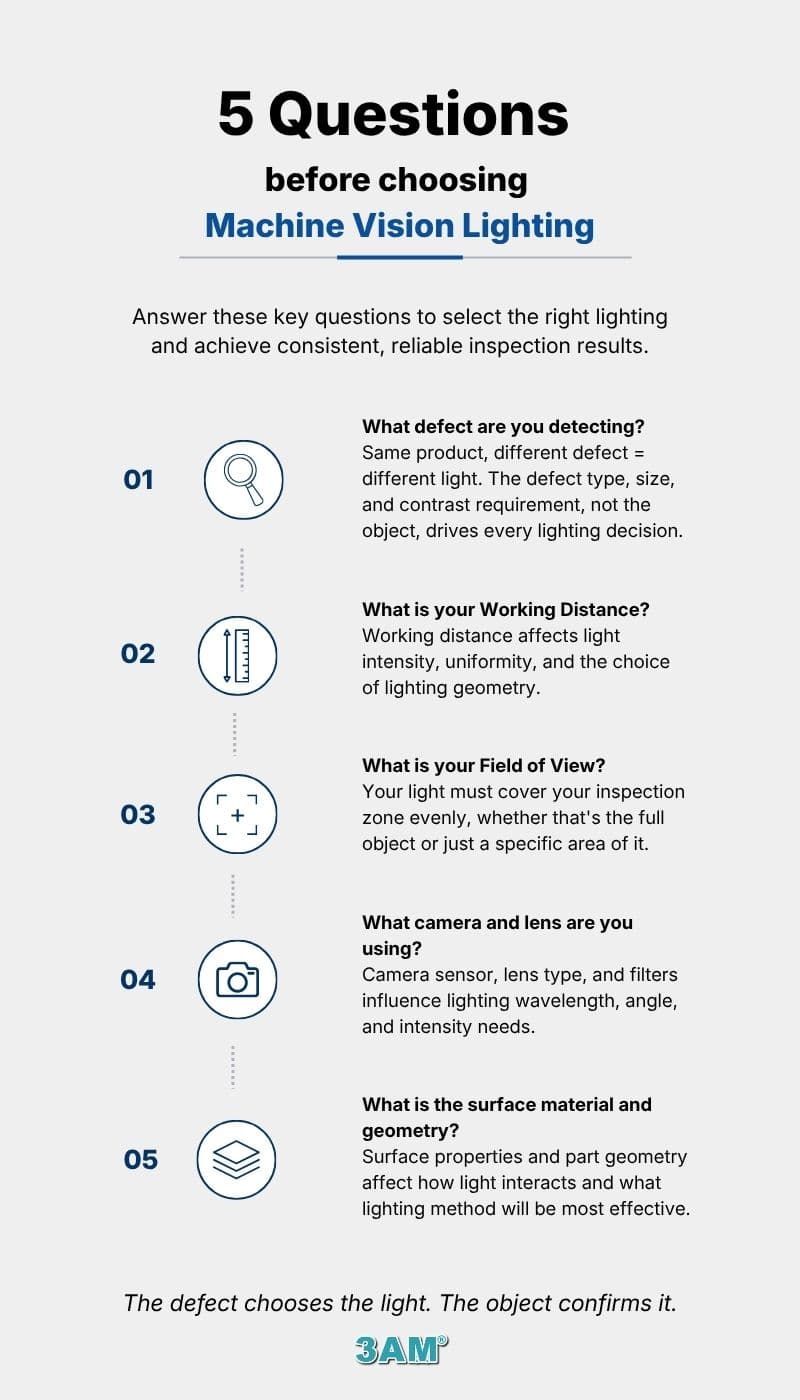
The 5 Foundation Questions
1. What kind of defect are you trying to detect?
This is the most important question — and the one most people skip.
Consider this: a PCB manufacturer may use three completely different lights on the same production line — a coaxial light to detect surface scratches on copper traces, a low-angle ring light to reveal solder joint shape, and a backlight to check drilling hole alignment. Same board. Three different inspection tasks = three different lighting solutions.
This is one of the most important things to understand about machine vision lighting: the object is never the unit of measurement. The defect is.
A scratch behaves completely differently under light than a solder bridge. A surface stain needs different illumination than a dimensional measurement. Without knowing what you're looking for, there is no correct lighting choice — only guesses.
Define before you contact a supplier:- Is the defect on the surface or beneath it?
- Is it a shape issue (crack, chip, missing part) or a contrast issue (stain, discoloration)?
- How small is the smallest defect you need to catch?
If you can share a sample image — even a phone photo — we can often narrow the direction immediately.
2. What is your Working Distance (WD)?
Working distance is the gap between the bottom of your light and the surface being inspected.
Every light performs optimally within a specific range. A ring light ideal at 100mm may produce uneven illumination at 200mm. Your working distance is usually fixed by your machine frame and camera mount — not something easily changed after installation. Knowing it upfront prevents purchasing a light that physically cannot work in your setup.
What to measure:- The fixed distance from your lens to the inspection surface
- Any height variation across different parts
- Whether the light must fit inside an existing housing or frame
3. What is your Field of View (FOV)?
FOV is the area your camera captures in a single image — your window of inspection.
Your lighting must illuminate that entire area evenly. If your FOV is 50mm × 50mm but your ring light only covers 30mm effectively, the corners of every image will be underexposed. That uneven illumination creates false defects and missed detections in your algorithm.
Matching light size to actual FOV — not just object size — is one of the most common and costly mistakes in machine vision system design. And note: some applications only require inspecting a specific zone of the object, not the full surface. Your FOV is defined by your inspection area, not the size of the part itself.
What to know:- Exact dimensions of the area you need to inspect
- Whether you capture in one shot or stitch multiple images
- Whether your FOV varies by product type
4. What camera and lens are you using?
The camera and lens determine how much light you need — and what kind.
A small sensor needs more light than a larger one. A narrow aperture (high f-number) cuts light significantly. A high-speed line camera capturing fast-moving parts needs brief, intense strobe pulses rather than continuous illumination.
What your supplier needs to know:- Sensor size and sensitivity
- Lens focal length and maximum aperture
- Exposure time and frame rate
- Continuous or strobe illumination requirement
If your camera isn't selected yet, finalize it before your lighting — the two must be designed together.
5. What is the surface material and geometry?
A flat matte surface and a curved polished metal surface are completely opposite challenges.
Highly reflective surfaces — wafers, glass, liquid crystal panels — create glare under direct lighting and typically require coaxial or diffuse dome illumination. Curved or 3D objects need low-angle lighting to reveal depth and edges. Transparent objects often require backlighting to show internal structure or contamination.
Key characteristics to identify:- Reflectivity: matte, semi-gloss, or highly reflective?
- Geometry: flat, curved, cylindrical, or complex 3D?
- Transparency: opaque, translucent, or transparent?
Going Deeper
Once the five foundation questions are answered, we often explore further:
- Production speed — Fast-moving parts require strobe lighting synced to the camera shutter to eliminate motion blur.
- Environment — Vibration, dust, oil mist, or extreme temperatures affect housing and durability requirements.
- New system or upgrade? — Existing equipment constrains options. Building from scratch opens more possibilities.
- Pass/fail tolerance — Defining exactly what constitutes a defect determines the contrast your lighting must create.
- Previous attempts — What have you already tried, and why didn't it work? This is often the fastest shortcut to the right answer.
What Happens After
With a clear picture of your defect, geometry, distances, camera, and environment — the recommendation becomes specific. A defined light type, wavelength, size, and intensity for your exact application. Backed by 20+ years of machine vision illumination experience across semiconductor, PCB, aerospace, medical, and industrial automation