


- Home
- News
- Knowledge Center
- The Role of Lighting in Machine Vision Systems
The Role of Lighting in Machine Vision Systems
Robots supply the muscle of automation. Machine vision supplies the eyes. AI supplies the growing ability to interpret and respond to complex environments. Together, these three technologies are reshaping how manufacturers, logistics providers, and critical industries approach productivity, quality, and operational resilience.
But there's a fourth component that rarely gets top billing, even though the other three depend on it completely: lighting.
Machine vision systems don't see the way humans do. A camera doesn't recognize a scratch or a misaligned part — it reads contrast, edges, brightness gradients, and pixel patterns, and hands that data to an algorithm for interpretation. Lighting is what determines whether that data is usable in the first place. Get it wrong, and no amount of camera resolution or AI sophistication will fix it downstream.
Lighting Determines Image Quality Before Software Ever Runs
Every machine vision pipeline starts with the same input: an image. If that image is inconsistent — variable brightness, low contrast, motion blur, sensor noise — the vision algorithm is working with corrupted data before it even starts.
Controlled, application-specific lighting produces:
- Clear edges, so parts, defects, and features are actually detectable
- Stable, repeatable contrast, so the same object looks the same every time it's inspected
- Reduced noise and blur, so exposure times can stay short even at line speed
Without this, a system isn't unreliable because the AI model is weak — it's unreliable because the eyes were never given a clear picture to interpret.
Lighting Controls the Variables a Factory Floor Won't
Manufacturing and logistics environments are visually hostile to cameras. Reflective metal surfaces, shifting shadows from moving equipment, mixed ambient light from skylights and overhead fixtures, and the constant motion of robots and conveyors all introduce variability that a fixed camera has no way to compensate for on its own.
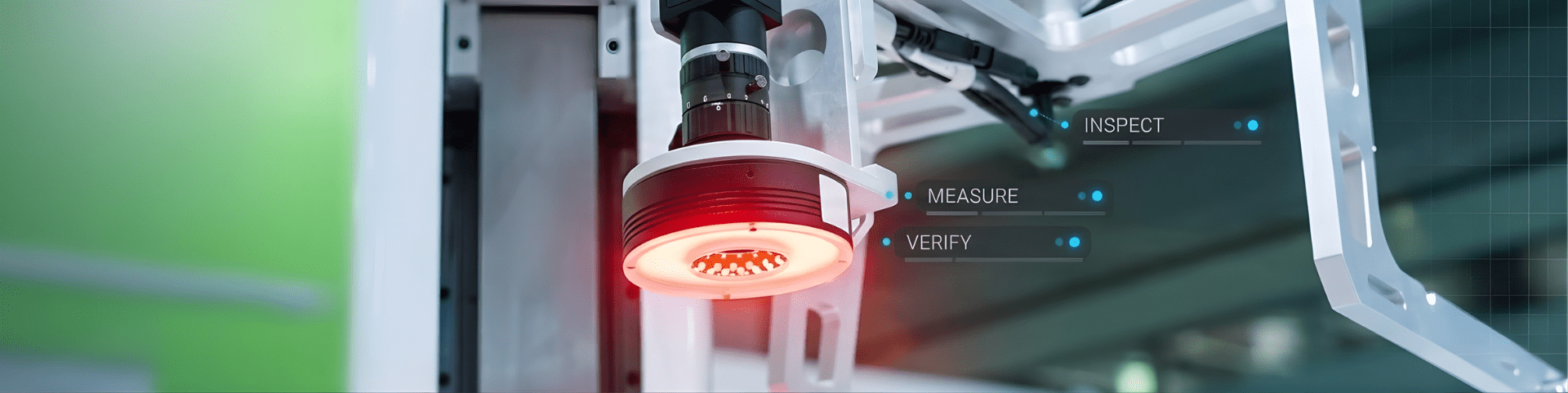
Purpose-built lighting — dome, bar, ring, or structured light, selected for the specific geometry and surface of the target — is what neutralizes that variability. It's the layer that lets a system trust what it sees regardless of what's happening in the rest of the facility.
Lighting Decides What the AI Is Even Able to Interpret
AI models don't interpret the physical world. They interpret pixels. Whatever the lighting fails to reveal, the model cannot recover — no amount of downstream processing power will invent detail that was never captured. Lighting decides:
- Which defects are visible: scratches, hairline cracks, misalignment, surface contamination
- Which features are emphasized and which are washed out
- Whether an inspection task is even physically possible with the current setup
In this sense, lighting functions as feature engineering for the physical world — the same way a data scientist selects which variables a model should see, an engineer selects which visual features the lighting should reveal.
Lighting Is a Direct Lever on Speed and Accuracy
Correct lighting shortens exposure time, reduces the need for retries, and cuts recalibration frequency. That translates directly into the metrics automation is supposed to deliver:
- Productivity — faster inspection cycles, higher throughput
- Quality — fewer missed defects, fewer false rejects
- Reliability — less drift, less manual recalibration, less unplanned downtime
The Simple Version
- Robot = muscle
- Machine vision = eyes
- AI = brain
- Lighting = the visibility system that makes the eyes trustworthy
Remove lighting from the equation, and the entire chain — vision, interpretation, decision, action — becomes unstable. It's not a peripheral component. It's the foundation the rest of the system is built on.
That's the standard we design to: lighting you spec once, calibrate once, and stop thinking about.